




 ACDSee
 Luminar Neo
 Apple Studio
 Leonardo AI
 CorelDRAW
 Lightroom
 Watermark
-
Latest Version
KiCad 10.0.5 LATEST
-
Review by
-
Operating System
macOS 10.15 Catalina or later
-
User Rating
Click to vote -
Author / Product
-
Filename
kicad-unified-universal-10.0.5.dmg
The suite runs on Windows, Linux, and macOS and is licensed under GNU GPL v3. The first release date was in 1992 by its original author, Jean-Pierre Charras, but is now currently under development by the KiCad Developers Team.
Schematic Capture
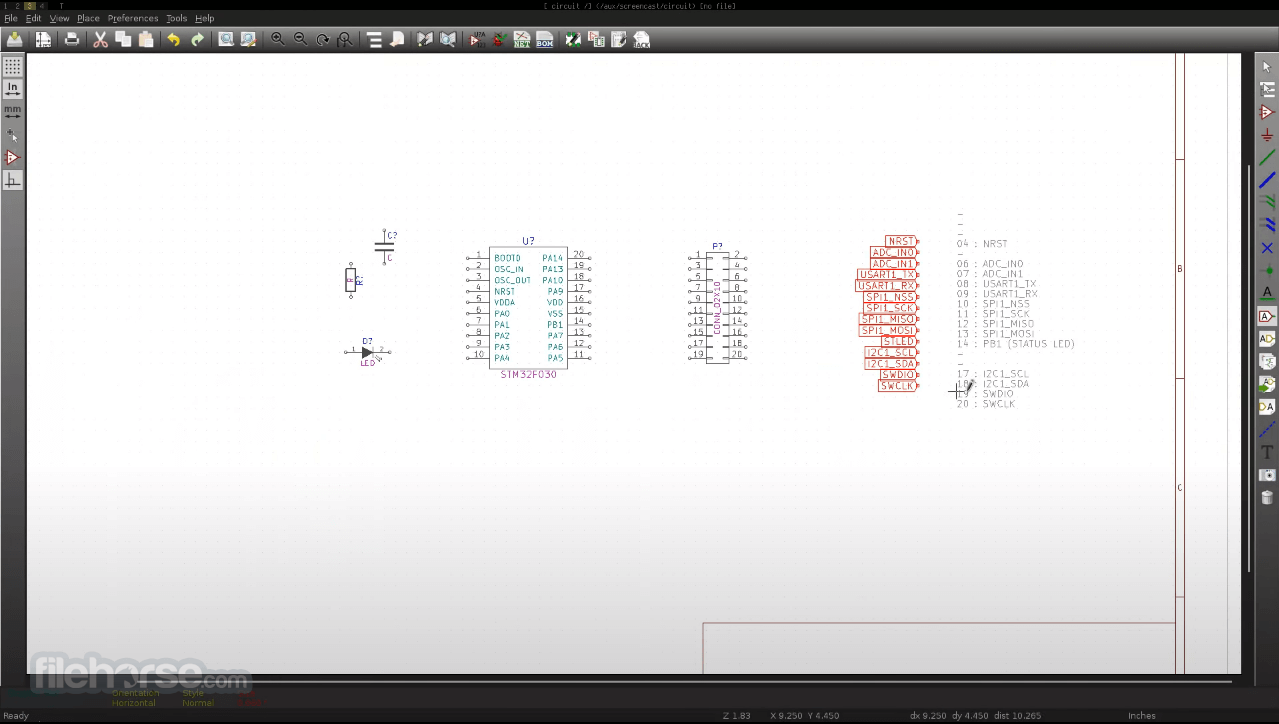
With the schematic editor, you can create your design without limit; there are no paywalls to unlock features. An official library for schematic symbols and a built-in schematic symbol editor help you get started quickly with your designs. Schematic capture is efficient, with all the tools you can expect for such a task.
The interface focuses on productivity. There are no complexity limits, as large designs can be divided into hierarchical subsheets. Various export options are available (PDF, SVG, HPGL, Postscript).
PCB Layout
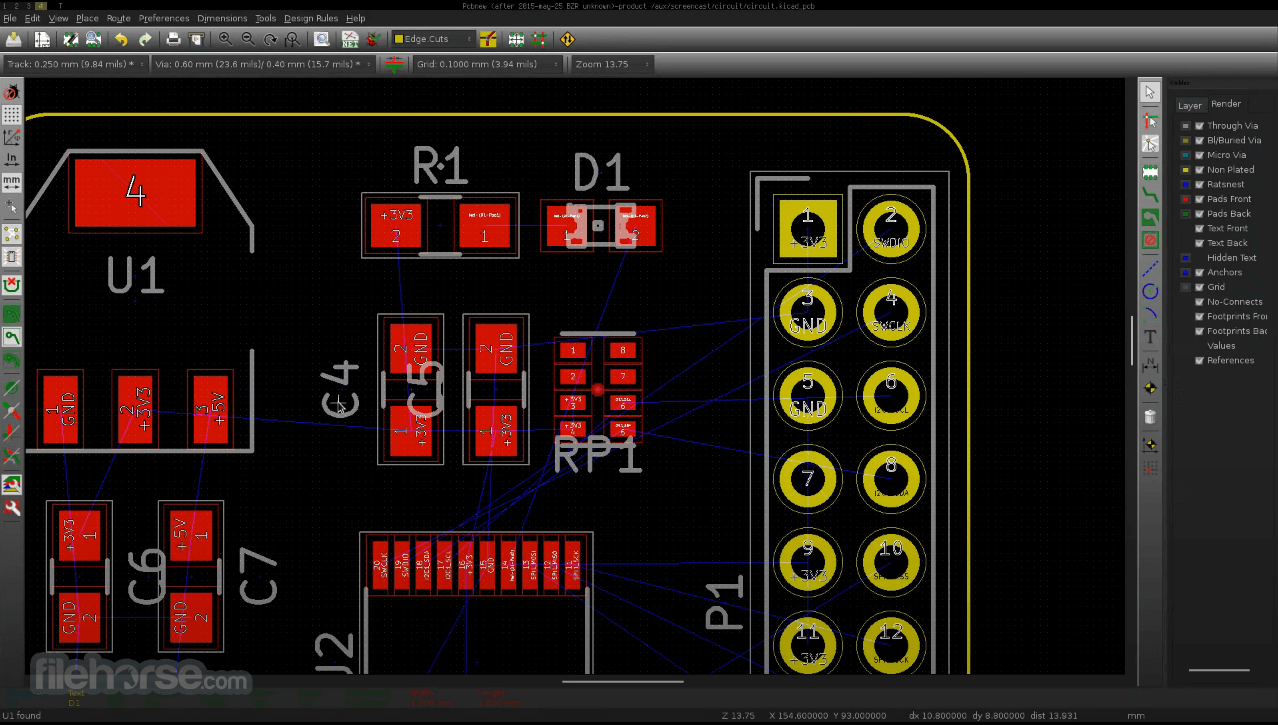
Make professional PCB layouts with up to 32 copper layers. KiCad for macOS now has a push and shove router which is capable of routing differential pairs and interactively tuning trace lengths.
This modern tool will help you layout your board faster. As you draw your track, it pushes forward traces that are in the way. If that is not possible, your track will be rerouted around obstacles. The push and shove router will make sure that your DRC constraints are respected.
3D Viewer
Ki Cad for macOS includes a 3D viewer that you can use to inspect your design in an interactive canvas. You can rotate and pan around to inspect details that are difficult to inspect on a 2D view.
Multiple rendering options allow you to modify the aesthetic appearance of the board or to hide and show features for easier inspection. When laying out your PCB, you can instantly inspect your design in an interactive 3D view. Rotate and pan around to inspect details easier than with a 2D display.
Features and Highlights
- Electrical Rules Check
- Export Netlists
- Bill Of Materials
- Integrated libraries
- Push and shove router
- Length tuning
- Footprint Editor (GAL)
- Install by dragging KiCad to Applications folder
- Launch the app and choose a project workspace
- Create a new schematic with Eeschema
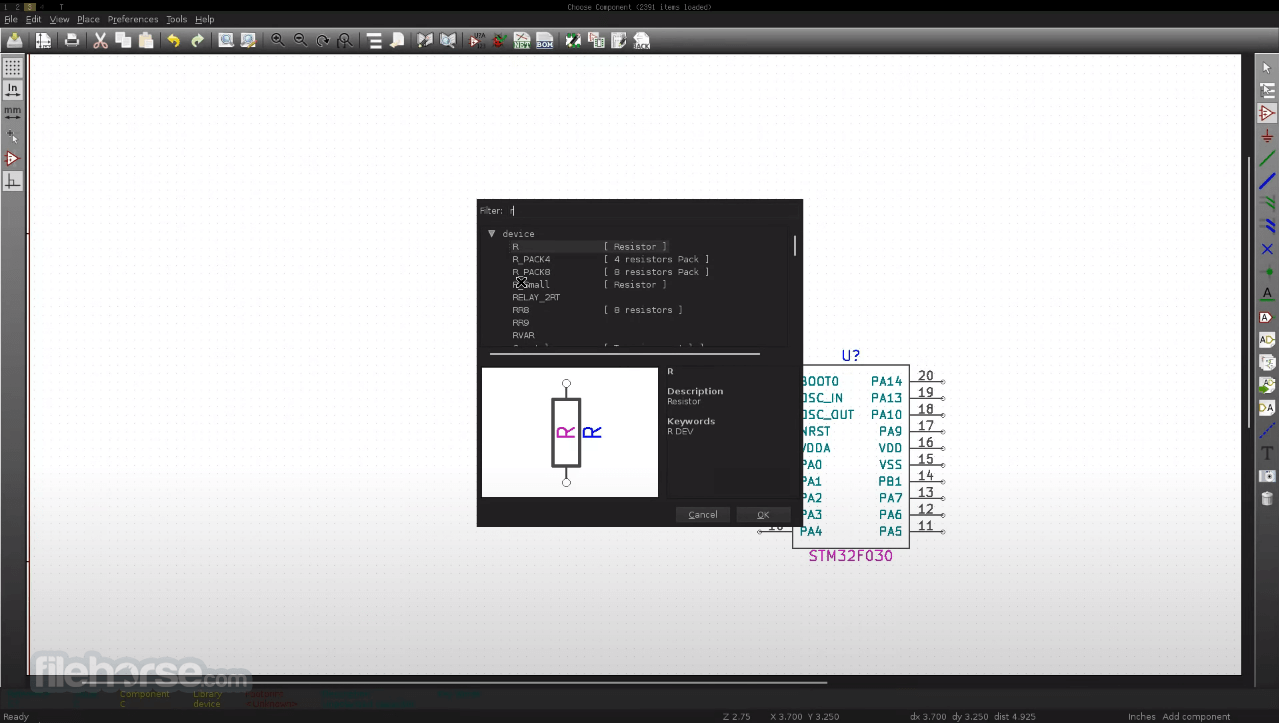
- Place components using the library browser
- Connect components with wires in the schematic
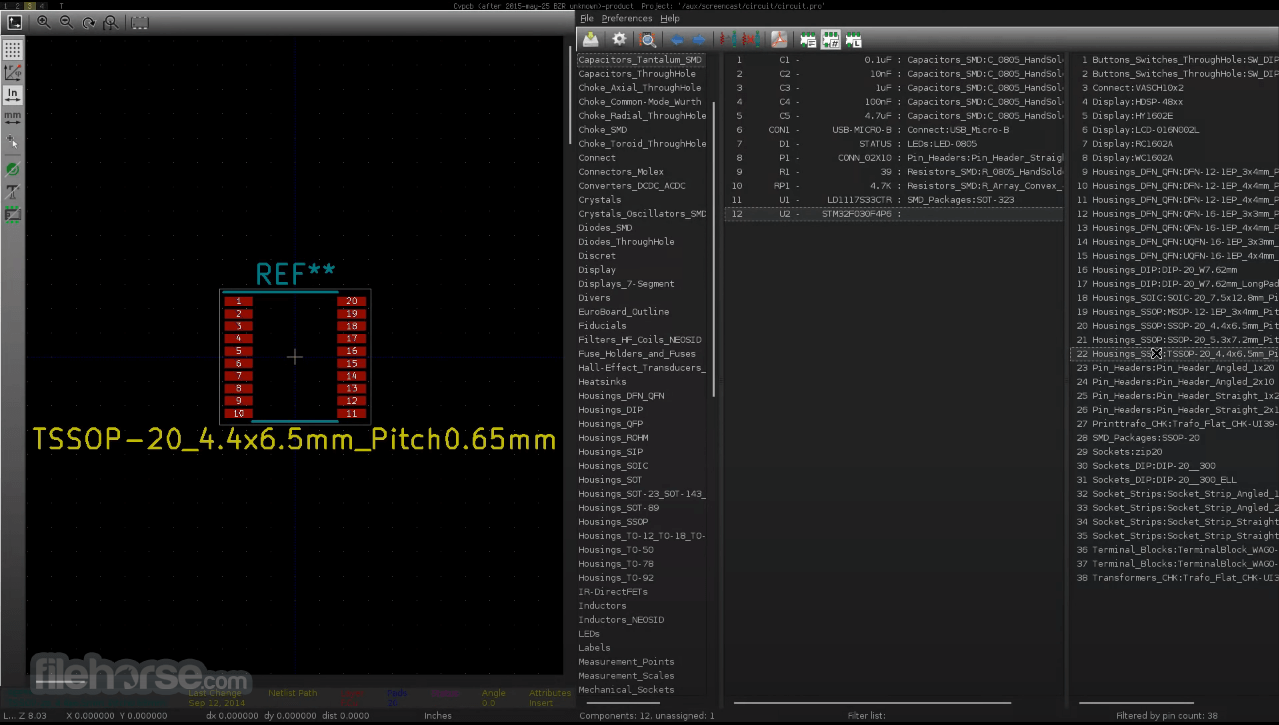
- Annotate components and assign footprints
- Switch to PCB editor to layout the board
- Route traces manually or use autorouter
- Run DRC to check for design rule violations
- Generate Gerber files for manufacturing
- Export BOM and other documentation
macOS 10.14 or later
64-bit Intel or Apple Silicon (ARM64)
4 GB RAM minimum (8 GB recommended)
1 GB free disk space
OpenGL-compatible GPU for 3D viewer
PROS
- Free and open-source EDA tool
- Cross-platform and regularly updated
- Powerful schematic and PCB editor
- Large library and community support
- Supports 3D rendering of PCB designs
- Occasional bugs in new releases
- UI less polished than commercial tools
- Limited autorouting capabilities
- Some libraries may need manual setup
-
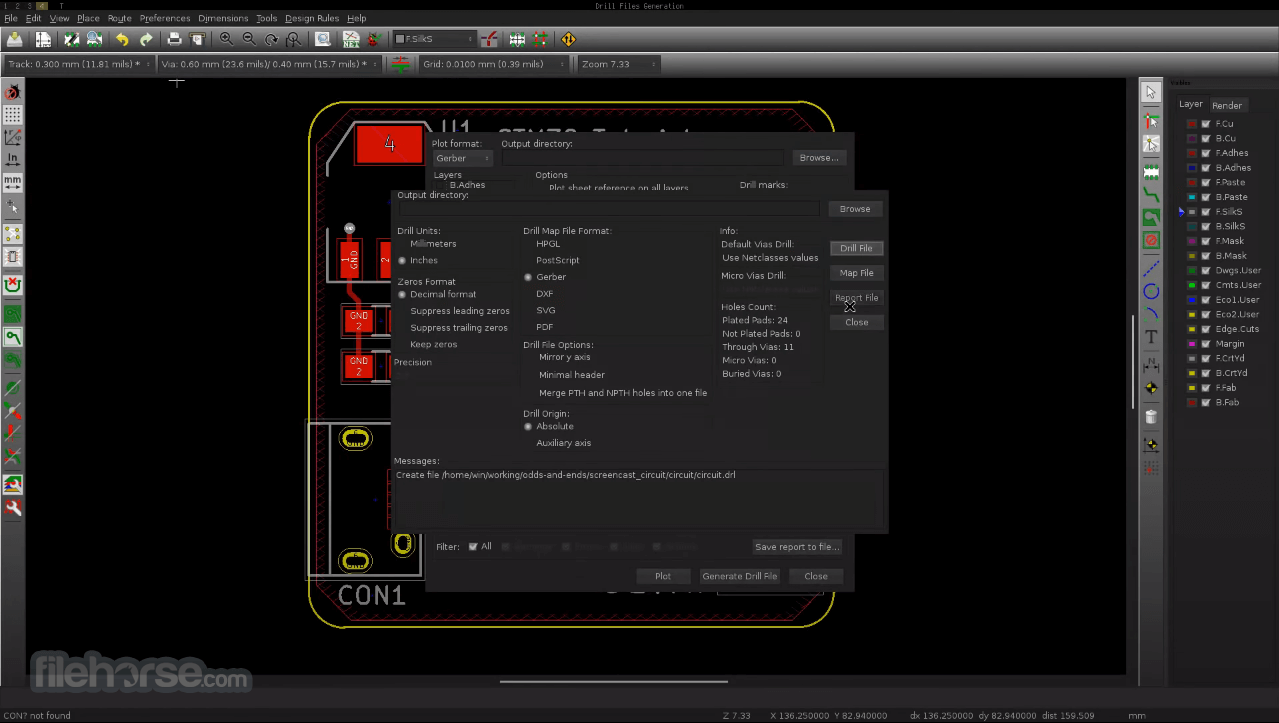
KiCad 10.0.5 Screenshots
The images below have been resized. Click on them to view the screenshots in full size.
-
-
-
-
What's new in this version:
KiCad 10.0.5
General:
- Persist visibility flag for design block libraries.
- Drop backlogged key auto-repeat events after release.
- Apply imported language without restart in start up wizard.
- Bound drawing dashed lines on huge geometry to prevent hang.
- Prevent crash migrating a nested library table row.
- Fix language specific bug when importing design blocks.
- Fix crash on exit.
- Recover from 3Dconnexion driver initialization crash.
- Don’t add stock libraries during migration if user had none.
- Add hotkeys for 'Exclude from Position Files' attribute.
- Show the full project path in the project manager status bar.
- Fix "Project Template Selector" dialog preview layout issue.
- Disable commit dialog OK button until a file is selected.
- Center a dialog when its title bar lands off-screen.
- Use correct wxString::Format string length specifier to prevent assertion (Sentry KICAD-NHC).
- Use title case for automatic save dialog buttons.
- Do not limit available substitution paths in library managers.
- Avoid illegal all zero dash array breaking exported PDF page rendering.
- Match rule check text markers anywhere in field.
- Gate library tree exact match to an item’s own name and library ID.
- Show the real zoom value in the toolbar zoom selector.
- Fix wrong stroke font thickness in PDF plot.
- Fix vector out-of-bounds access when rows have different column count when decoding CSV files.
- Fix crash on automatic history save.
- Key autosave mechanism on the backup format.
- Fix stale pointer crash in rule check tree.
- Fix incorrect multi-line spacing for outline fonts.
- Clamp dialog restored geometry to its display to prevent them from being hidden.
- Fix grid highlight glitch when opened on an inactive page.
- Match PDF stroke font tab stops to on screen rendering.
- Scope git commit checklists to the project directory.
- Fix crash when creating new color swatch with invalid parent (Sentry KICAD-R33).
- Fix crash when closing main windows. (Sentry KICAD-14MP, KICAD-140, KICAD-1E9, and KICAD-420).
- Fix crash on invalid git repo under a running background git task (Sentry KICAD-PGX, KICAD-SQC, KICAD-RWP, KICAD-RZP, and KICAD-RWG).
- Use correct aspect ratio in PDF stroke fonts.
- Refresh bitmap button when its bitmap changes.
- Use default wxWidgets AUI tab art style base instead of generic in notebooks.
- Make local history restore non-destructive.
- Don’t show a system error dialog for local history on read only projects.
- Fix inflated outline font multi-line spacing.
Schematic Editor:
- Resolve text variables in hierarchical sheet file paths.
- Show effective DNP on symbols inside a DNP sheet.
- Fix small arc snapping during edits.
- Keep default project template available regardless of user template folder.
- Prevent variant information from being copied from another project.
- Prevent crash on HTTP library network loss.
- Apply net-class color and style to hopped wires when plotting.
- Fix inconsistent "symbol doesn’t match copy in library" ERC warning.
- Do not rebuild database symbol cache on unrelated library activity.
- Prevent embedded file loss when adding a new embedded file to a symbol.
- Place dragged wires on the correct hierarchical sheet.
- Prevent duplicate "KiCad Defaults" color schemes in plot dialog.
- Ignore UNITS field for schematic geometry when importing PADS schematic.
- Do not replace symbol value with ${SIM.PARAMS} when checkbox to store parameters in value field is unchecked.
- Prevent infinite loop caused by self referential symbols.
- Refresh database symbol caches so chooser panels agree.
- Include Earth and VSS nets on ground pin ERC.
- Report real connectivity reason for multi-channel topology mismatch.
- Fix ERC quick-fix to open "Update Symbols" not "Change Symbols".
- Fix symbol annotation issues when pasting.
- Fix crash when deleting design blocks with "Select All".
- Fix assertion when attempting modal close of find dialog (Sentry KICAD-17XV).
- Fix memory leak in two click place tool.
- Don’t copy text when resolving variables.
- Fix laggy and frozen input in the "Assign Footprints" tool.
- Fix ERC footprint filter marker error code.
- Fix bus labels and unnamed sheets on Altium import.
- Italicize derived import symbol names.
- Handle arcs in sch connection paths on CADSTAR import.
- Warn instead of abort on unknown nodes on CADSTAR import.
- Prefer clipboard library symbol on paste.
- Keep bus labels when duplicating a sheet.
- Only save BOM output file name on "OK", "Apply", or "Export" buttons in fields table dialog.
- Fix overlapping pins when automatically placing sheet pins.
- Dim bus sheet pins when the sheet is marked DNP.
- Don’t match symbols on field text in find.
- Move a selected table with the rest of the selection.
- Group repeated multi-segment wires into a single undo step.
- Mirror stacked pin number block with the symbol.
- Fix pin number position on rotated symbols.
- Import repeated Altium sheet instances.
- Prevent zoom to fit crash after destroyed tool manager (Sentry KICAD-81S).
- Prevent execute remote command crash from null tool manager(Sentry KICAD-KICAD-5ME).
- Fix crash when saving pathless symbol instances (Sentry KICAD-173B).
- Fix crash when DRC marker has no associated item (Sentry KICAD-YT2 and KICAD-YTA).
- Fix crash when updating connectivity subgraph with stale item pointer (Sentry KICAD-4SJ and KICAD-10HY).
- Parent the new variant dialog to the window that opened it.
- Fix crash after attempting to undo renaming a sheet.
- Fix hotkey crash over grouped items.
Symbol Editor:
- Allow overwriting an existing file when creating a library.
- Require at least two custom body styles when custom body style symbol properties is set.
- Do no show inherited fields from derived symbols in properties dialog.
- Fix crash when moving text items and pin while editing custom symbol libraries.
- Fix missing rectangle fill mode when importing Eagle symbol library.
- Add missing HTTP library fields content in the symbol selector.
- Use left/right arrow keys collapse/expand the library tree.
- Enable "Update Symbol Fields" for derived symbols.
- Treat user field names case-sensitively in the fields tables.
Simulator:
- Fix memory leak in IBIS parser.
- Fix CPL SPICE model multi-parameter parsing.
- Prevent axis legends and tick labels from being unreasonably small.
- Don’t warn about discarding IBIS waveform pairs when none are discarded.
Board Editor:
- Apply clearance rules when dragging arc tracks.
- Draw lock shadow for locked dimensions.
- Scroll to the current footprint when opening the footprint chooser.
- Fix back drill must cut handling in via properties.
- Rescue undefined-layer items to Cmts.User layer correctly on STEP export.
- Preserve destination layer names when appending a board.
- Fix isolated vias randomly changing nets on undo/redo.
- Include tables and bar codes on the Edge.Cuts layer DRC.
- Connect small same-net vias in solid hatch fill.
- Keep grouped items in their group through undo and redo.
- Fix smashed part and plain PCB text angle and adjustment on Eagle import.
- Keep copper and solder mask text coincident on Altium import.
- Correctly calculate creepage DRC path from rectangular pads with arbitrary rotation.
- Accept zero as a valid vertex coordinate when editing corners.
- Prevent 'Update PCB from Schematic' from adding spurious 'Do not place' fabrication attribute to all non-DNP footprints.
- Prevent solder paste clearance from being lost when pressing 'Enter' in pad properties.
- Prevent teardrop generator from shorting nets when creating copper over knockout copper text.
- Fix crash when entering a group.
- Fix crash attempting to highlight a net from the net inspector panel.
- Fix migration issue when opening version 8 board.
- Prevent run failure due to undefined symbols on plugin availability check.
- Import length-tuning meanders as tuning patterns when importing Altium board.
- Fix ASCII text encoding, back-side mirror, and finger pad rotation on PADS import.
- Fix IPC-2581 flipped footprint rotation.
- Guard repeat layout against duplicate placement areas.
- Don’t clone unrelated groups in repeat layout.
- Prevent corruption when creating an array of grouped items with tuned tracks.
- Fix multi-track drag crash on short tracks.
- Correctly calculate creepage DRC paths around fully rounded rectangle slots in Edge.Cuts.
- Fix teardrop drop on elongated oval pads.
- Include all user layers in Gerber job file.
- Fix incorrect and missing back drill DRC.
- Drop auxiliary origin from netlist net points on ODB++ export.
- Propagate net change to connected track segments.
- Render single-layer pads on inner copper layers.
- Apply dog bones to any selected line pair.
- Enable "Import" button when performing "Import Settings from Another Board".
- User current file chooser path when performing "Import Settings from Another Board".
- draw rule-area outline above copper so tracks don’t cover it.
- Clear drawn margin layer lines after undo.
- Emit plated slotted holes in ODB++ drill output.
- Prevent 3D model modification failure when using custom layers used by footprint.
- Reject spurious arc fits when exporting to STEP.
- Improve rendering performance by not re-tessellating unaffected items on edit.
- Keep other copies routing when applying a design block layout.
- Prevent let design block net collisions with the board on apply.
- Prevent "Apply Design Block Layout" from swapping identical footprints.
- Fix crash when undoing a footprint field converted to a rule area.
- Keep tuning profile from always implying time domain tuning.
- Set drill and place origins on Eagle import.
- Apply design block layout when board connectivity differs.
- Fix crash when editing zone name on board with no zones.
- Merge arc tracks to fix incorrect differential pair skew.
- Remember the 3D model export file name per project.
- Keep nested schematic groups nested when updating the PCB.
- Clear arcs before calling boolean op on SHAPE_POLY_SET to prevent assertion (Sentry KICAD-PX3).
- Fix crash when flipping board layer (Sentry KICAD-174H).
- Reconcile properties inspector and track and via dialog for back drills.
- Close hairline gaps when healing curved board outlines.
- Reconcile same net zone overlaps in iterative refill.
- Improve group save performance.
- Import keepout/keepin/constraint areas as rule areas on Fabmaster import.
- Fix "Viewports" title changing to "Presets" after saving a preset.
- Fix crash in "Net Inspector" filter.
- Fix crash when placing footprints.
- Prevent overly narrow copper bridge on zone fill.
- Do not freeze the entire program periodically for several seconds with complex boards on automatic save.
- Import route arc corner as arc center not a vertex on PADS import.
- Handle V5 and earlier text format on PADS import.
- Handle RF and square pads with corner radius on PADS import.
- Handle routes with no explicit ROUTEWIDTH on CADSTAR import.
- Paste copied arc on grid.
- Keep the selection when locked items block an action.
- Fix crash when editing a footprint with a field in a group.
- Fix odd-count GLB LINES rejected by Blender on 3D model export.
- Do not dropping shapes at sub-tolerance spline junctions on DXF import.
- Honor layer pair for via to all copper ratsnest target when routing.
- Fix wrong corner angles on zones with cutouts.
- Prevent cleared net colors from coming back.
- Fix creepage path cutting across rounded slots.
- Allow copper pour over back-drill via to be automatically adjusted when back-drill bottom is set.
- Fix smashed part and plain PCB text angle and adjustment on Eagle import.
- Show drill marks on SVG and PDF plots.
- Don’t let find clobber the selection during a move.
- Keep inner-layer pad and via rings when a zone connects to them.
- Keep knockout on footprint text when updating from library.
- Fix wrong creepage distance between overlapping board cutouts.
- Fix teardrops near close vias and pads.
- Prevent zone filler from generating illegal narrow slivers that violate minimum width constraints.
- Allow unlocking footprints when one of the attributes is locked.
- Fix crash on retry after failed STEP export (Sentry KICAD-QF).
- Fix crash when updating view with descendants of deleted items (Sentry KICAD-PNP and KICAD-PPN).
- Fix crash on STEP export (Sentry KICAD-8PD).
- Fix crash when accessing footprint libraries (Sentry KICAD-YVH, KICAD-R00, and KICAD-1582).
- Rethread OCC boolean ops safely with non-destructive mode (Sentry KICAD-8PD).
- Match PDF stroke text glyph offsets to Gerber.
- Fix multichannel topology match across three or more channels.
- Improve label/control positioning and high-DPI support in "DRC Rule Editor".
- Fix layer name matching.
- Align constraint controls by Y center in "DRC Rule Editor".
- Improve "DRC Rule Editor" field positioning for slightly larger fonts.
- Don’t duplicate footprints on update when replace is off.
Footprint Editor:
- Keep libraries expanded in tree after deleting a footprint.
- Fix crash when working from network share.
- Assign unmapped Eagle layers to User.Drawings, Margin and User 1-9.
- Fix crash when opening other footprint while drawing rectangle mode is active.
3D Viewer:
- Properly save and load User.1-45 and grid axes layers in presets.
- Allow deselecting by clicking empty space.
- Hide non-active variant footprints.
- Adjust polygon offsets to avoid Z-fighting between board body, copper, soldermask, and silkscreen.
Gerber Viewer:
- Read the Excellon repeat hole ® command.
- Page Layout Editor:
Job Sets:
- Use the right-clicked row in the "Jobset" editor context menu.
- Fix absolute paths with space in Execute on Windows.
- Allow using internal Python on Windows instead of the system Python.
- Improve DRC performance due to excessive reporter UI updates.
- Fix output recording in "Execute Command".
Command Line Interface:
- Make PCB render --use-board-stackup-colors a simple on/off flag.
- Prevent crash on zone fill against a missing DRC engine.
- Correctly show reason for board load failures.
- Accept directory format symbol libraries (unpacked) in symbol SVG export.
- Export SVG for a single symbol file from a directory library.
 OperaOpera 134.0 Build 5954.26
 PhotoshopAdobe Photoshop CC 2026 27.9.1
 OKXOKX - Buy Bitcoin or Ethereum
 WPS OfficeWPS Office
 Adobe AcrobatAdobe Acrobat Pro 2026.001.21771
 CleamioCleamio 3.4.0
 MalwarebytesMalwarebytes 5.25.2
 TradingViewTradingView - Track All Markets
 CleanMyMacCleanMyMac X 5.2.10
 AdGuard VPNAdGuard VPN for Mac 2.9.0
Comments and User Reviews